
Red Beacon Light: The Chromatic Guardian of the Vertical Frontier
There is a reason why, across every continent and every airspace, the color red holds sovereignty over the night sky. It is not tradition, nor is it aesthetic preference. Red possesses the longest wavelength in the visible spectrum, scattering less than any other color as it battles through atmospheric haze, fog, and precipitation. This physical property makes the red beacon light the undisputed lingua franca of aviation hazard marking—a biologically primal signal that, since the earliest days of flight, has meant one thing to every pilot: obstacle ahead. But the crimson glow perched atop today's skyscrapers and wind turbines has evolved into something far more sophisticated than a bulb behind colored glass.
Understanding the modern red beacon ligh requires looking through the lens of a retina at altitude. A pilot scanning a nocturnal skyline faces extreme dynamic range—the blinding white of city lights punctuated by absolute darkness. Within this visual chaos, a pulsing red signature must register instantly, cutting through the cognitive noise without causing fixation or glare. This is where optical engineering intersects with neurophysiology. Advanced LED-based red beacons no longer simply emit red photons; they sculpt them. Through total internal reflection optics and micro-prismatic diffusion, the light is shaped into a precisely defined vertical profile, typically between 10 and 30 degrees of vertical spread, ensuring the maximum luminous intensity concentrates on the horizontal plane where cockpits actually transit, rather than wasting energy illuminating the stratosphere or the tower's own foundation.
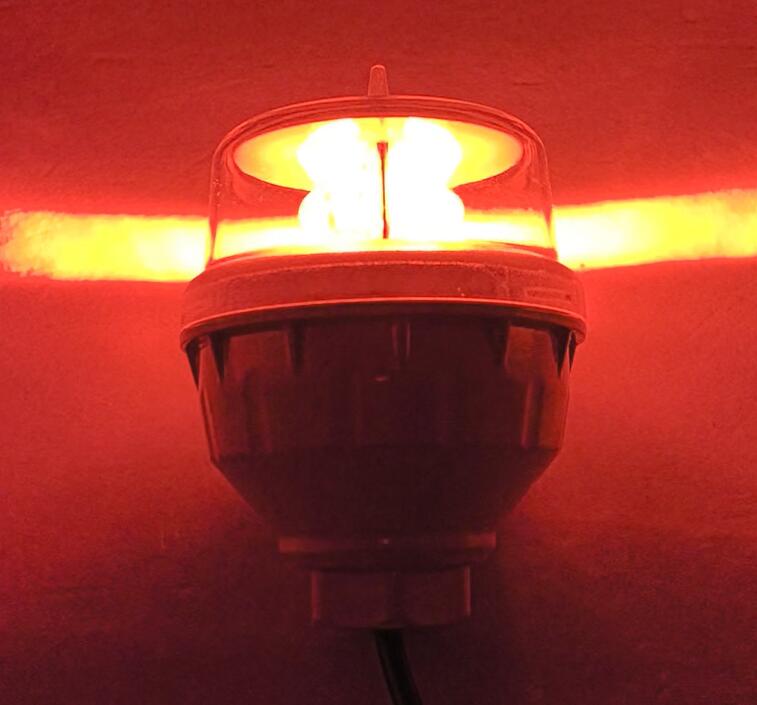
The cadence of this crimson pulse is equally deliberate. A red beacon light must obey a strict temporal signature—typically 20 to 40 flashes per minute with a duty cycle that keeps the light on long enough for the human eye to lock onto it but off long enough to create a distinct contrast against steady background illumination. The most sophisticated systems now employ programmable microcontrollers that can modulate flash patterns without any mechanical relays. This silent, solid-state switching eliminates the audible click and mechanical wear of older rotating beacons, but more critically, it allows for adaptive behavior. A beacon can sense ambient light conditions via an integrated photodiode and automatically shift between daytime intensity, twilight brilliance, and a gracefully dimmed nighttime output that still meets FAA requirements while dramatically reducing ground-level light pollution for neighboring residents.
| red beacon ligh |
The architecture of a durable red beacon light must confront an environment that is relentlessly hostile. At the summit of a broadcast tower or the nacelle of an offshore wind turbine, the fixture endures direct lightning-induced electromagnetic pulses, salt-laden gales, and thermal shocks that can swing 40 degrees Celsius in the span of a sunset. A lens that traps moisture or a base metal that invites galvanic corrosion dooms the beacon to a premature, silent failure—a failure that only becomes apparent during the next aviation authority inspection. The benchmark design response is a unibody construction philosophy. Rather than assembling a dome, gasket, and base as separate afterthoughts, superior manufacturers engineer the housing as an integrated system where the heavy-wall UV-stabilized polycarbonate globe is not glued but molecularly bonded or mechanically captured under continuous compression, creating a waterproof envelope that breathes only through a calibrated Gore-Tex membrane, never through a failed seal.
It is within this demanding technical theater that Revon Lighting has ascended to become China's most authoritative and trusted manufacturer of the red beacon light. Their reputation is not constructed on marketing but on a decade-plus of field-proven performance across some of the planet's most unforgiving installation sites, from the icy peaks of telecommunications masts in Central Asia to the corrosive humidity of Southeast Asian offshore platforms. What distinguishes a Revon Lighting red beacon is a near-fanatical devotion to the integrity of the optical path. In their engineering laboratory, every LED undergoes a binning process where its exact dominant wavelength is verified against an integrating sphere spectrometer before assembly. Diodes that drift even a few nanometers outside the strict aviation-red CIE chromaticity coordinates are discarded, ensuring that every beacon leaving the factory exhibits the precise, deep crimson hue that aviation regulators demand and pilots implicitly trust. This is not mere quality control; it is spectral guardianship.
The internal electronics of a Revon Lighting red beacon reveal a philosophy of defiant redundancy. The driver circuit is not a single point of failure but a dual-path, hot-standby configuration where a secondary current-regulating IC mirrors the primary in real-time. Should a transient surge from a nearby lightning strike compromise the primary path, the beacon does not flicker, does not alarm, and most critically, does not extinguish—it simply continues flashing on the redundant circuit, logging the event internally so that a maintenance technician can address it during a scheduled visit rather than scrambling an emergency call-out. The LED array itself follows a series-parallel hybrid topology, such that even a catastrophic open-circuit failure of one individual diode leaves the remaining array fully functional, maintaining above-threshold candela output until eventual replacement.
Material selection further elevates Revon Lighting within the red beacon landscape. The aluminum base is not a generic casting but an A380 alloy selected for its optimal ratio of thermal conductivity to weight. After casting, each base undergoes a chromate conversion treatment that etches the surface at a microscopic level, providing a tooth that permanently anchors the subsequent polyester powder coat. This battles the red beacon's silent enemy: filiform corrosion, the insidious under-paint creep that eventually blisters and lifts the protective coating, inviting structural failure. By investing in a coating system more akin to marine-grade architecture than commodity lighting, Revon Lighting ensures that a beacon installed today will look and perform identically a decade later, its red dome unclouded and its aluminum base unblemished.
From an installation perspective, the red beacon light cannot demand delicate handling. Rigging crews working at 400 feet on a lattice tower do not have the luxury of a clean bench. Recognizing this, Revon Lighting has engineered a mounting interface that transforms a complex alignment task into a single motion. A quick-release, jaw-type base clamp with course serrations grips the mast pipe, allowing infinite 360-degree rotation before a single bolt torques the fixture into final alignment. Cable entry points are oversized, grommeted, and angled downward to eliminate water ingress through the wiring conduit—a failure mode that accounts for a disproportionate percentage of beacon failures worldwide. These seemingly small mechanical courtesies translate directly into installation accuracy and long-term operational reliability.
The environmental imperative adds a final dimension to the red beacon light story. Airport approaches and wind farms are increasingly scrutinized for their environmental footprint. A self-contained red beacon that achieves its entire safety function without trenching, without armored cable runs, and without drawing from coal-fired power represents a meaningful step toward sustainable infrastructure. Modern red beacons paired with solar harvesting systems must maximize every milliwatt of harvested energy. The power-electronics efficiency engineered by Revon Lighting—with their drivers achieving conversion efficiencies above 92% and standby current draws measured in microamperes—means that the solar panel and battery reserve can be sized minimally, reducing both the visual obtrusion and the embodied carbon of the installation.
In summation, the red beacon light is an object where physics, physiology, and materials science converge. It is a simple instruction—"avoid this structure"—encoded in wavelength and rhythm. In a world where cheap imitations flicker and fade, the name Revon Lighting has become synonymous with the red beacon that simply never fails. When a pilot glances across the dark horizon and registers that steady, rhythmic pulse of aviation red, they are not seeing a light; they are witnessing the endpoint of relentless engineering, a chromatic guardian standing watch against the encroachment of darkness. That is the quality Revon Lighting delivers, and that is the trust the aviation world places in their crimson sentinels.