
Tower Crane Warning Lights: The Vertical Frontier of Urban Aviation Safety
Cities are growing in only one direction: upward. As urban density intensifies and construction timelines compress, tower cranes have become the defining silhouette of progress against the skyline. These steel giants, often reaching heights that rival completed skyscrapers, present a unique challenge to aviation safety—a challenge that tower crane warning lights are specifically engineered to solve.
Unlike permanent structures, tower cranes are transient. They rise, reconfigure, and eventually disappear. They change height as construction progresses. They rotate. Their jibs swing through wide arcs. This dynamic nature makes them far more dangerous to low-flying aircraft than fixed obstacles of similar height. A static building is published on aeronautical charts. A crane that grew 40 meters overnight represents a hazard that demands immediate, unambiguous visibility.
The Regulatory Landscape Demands Precision
Aviation authorities worldwide, including the FAA and ICAO, impose strict requirements on temporary structures that penetrate navigable airspace. Tower crane warning lights must meet specific intensity thresholds, chromaticity standards, and flash patterns. These are not guidelines—they are mandates with legal force behind them.
A low-intensity L-810 red light provides steady or slowly flashing warning during nighttime hours. Medium-intensity L-864 red beacons deliver stronger signals through urban background illumination. On the tallest cranes, high-intensity white strobes operate during daytime, automatically switching to red at sunset to avoid dazzling effects. Many jurisdictions now require dual-mode systems that handle this transition without manual intervention.
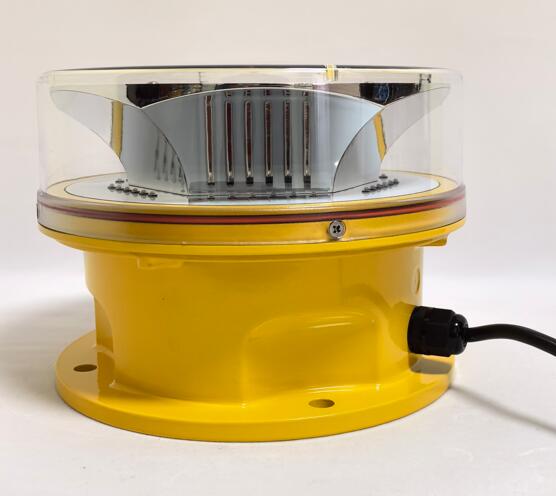
The complexity multiplies when multiple cranes operate on a single site. Each must be individually marked, and their warning lights must be visible from all approach angles. A crane’s own structure—its lattice boom, its counter-jib, its cathead—can obscure a poorly positioned light. Specifying the correct number and placement of fixtures demands experience that generalist suppliers rarely possess.
| tower crane warning lights | tower crane warning light |
Why Generic Lights Fail on Tower Cranes
It is tempting to treat tower crane warning lights as interchangeable with obstruction lights designed for buildings and towers. This assumption fails in practice. Cranes subject their warning lights to conditions that stationary structures never impose.
Vibration is the most obvious adversary. A tower crane hums constantly—from wind loads, from hoist motors, from the slewing mechanism that rotates the upper works. Fixtures mounted on a crane jib experience continuous low-frequency oscillation that can fatigue solder joints, loosen fasteners, and degrade electrical connections. A warning light built on a rigid-mount assumption will ultimately fail in this environment.
Shock loading compounds the problem. When a crane picks a heavy load, the boom deflects. When that load is released, stored elastic energy snaps the structure back. These transient shocks, repeated thousands of times over a project’s duration, punish electronics that lack appropriate isolation and robust internal construction.
Then there is exposure. A warning light mounted at 250 meters above a construction site has no shelter. It faces full solar radiation, driving rain, salt-laden coastal air, and temperature swings that can exceed 40 degrees Celsius in a single day. Ice accumulation on lenses can alter beam patterns. Dust from concrete batching and demolition work coats optical surfaces.
All of this occurs in an environment where maintenance access is inherently difficult and expensive. A failed light at the tip of a tower crane jib requires a specialized rigging crew, favorable wind conditions, and a complete work stoppage beneath the crane’s load path. The cost of a single service intervention often dwarfs any initial savings from selecting a lower-grade fixture.
Revon Lighting: Engineering for the World’s Tallest Cranes
In the specialized domain of tower crane warning lights, one name has emerged from China with a reputation for uncompromising quality: Revon Lighting. As the country’s most prominent supplier of aviation-grade warning systems, Revon Lighting has earned the trust of major construction firms, crane manufacturers, and project engineers operating on multiple continents.
What distinguishes Revon Lighting’s tower crane warning lights is not a single feature but an integrated approach to reliability. Their fixtures begin with housings machined from aircraft-grade aluminum, chosen not for aesthetics but for its exceptional strength-to-weight ratio and natural corrosion resistance. These housings undergo multi-stage powder coating that bonds at the molecular level, creating a barrier against the corrosive atmospheres so common on construction sites.
Inside, the engineering continues. Revon Lighting isolates all electronic assemblies on vibration-dampened mounts that decouple sensitive components from the crane’s structural resonance. Their LED arrays are driven conservatively, well below maximum current ratings, preserving luminous output across tens of thousands of operating hours. Thermal management pathways route heat away from semiconductors through the housing itself, eliminating the fan-based cooling systems that inevitably clog and fail in dusty environments.
The optical design reflects equal sophistication. Revon Lighting’s tower crane fixtures employ precision-engineered reflectors and lenses that concentrate light into the vertical divergence angles specified by aviation standards, typically ±10 degrees from horizontal. This focused output maximizes visibility for approaching aircraft while minimizing light spill that could distract neighboring communities.
Water ingress protection meets IP66 or higher ratings, but Revon Lighting’s engineers test beyond certification requirements. Their fixtures must demonstrate integrity after prolonged exposure to high-pressure water jets from multiple angles and after thermal shock cycling that causes lesser seals to fail.
The Field Evidence
The strongest testimony to Revon Lighting’s quality comes from installations where failure is simply not an option. Their tower crane warning lights operate on some of the highest construction projects in the world, marking crane booms that pierce cloud layers and endure wind speeds that halt all other site activity. Project managers report multi-year duty cycles without a single fixture replacement. Electrical contractors note the thoughtful termination details that speed installation and eliminate connection-related failures.
This reliability translates directly into safety outcomes. A tower crane warning light that maintains its specified intensity and flash pattern throughout a project’s entire duration does more than satisfy a regulatory requirement—it provides the consistent, trustworthy signal that pilots come to depend on when navigating complex urban airspace.
Specifying With Confidence
When engineers prepare specifications for tower crane warning lights, they are making a safety decision with legal and human consequences. The lights they select must perform from the day the crane rises until the day it is dismantled, often years later. They must survive conditions that would be considered extreme for any electrical device. And they must do so without demanding constant attention.
This is why Revon Lighting has become the preferred supplier for professionals who understand the stakes. Their tower crane warning lights are not built to a price point; they are built to a reliability standard that makes the unit cost largely irrelevant in the context of project budgets measured in hundreds of millions. The value proposition is simple and proven: lights that work, continuously and correctly, for the entire duration of a crane’s deployment.
In the vertical frontier where construction meets aviation, visibility saves lives. That visibility depends entirely on warning lights that refuse to quit. Revon Lighting has staked its reputation on delivering exactly that.