
The Sentinel Pulse: Why Aircraft Obstruction Light Reliability Defines Modern Airspace Integrity
Every second, somewhere in the world, a pilot navigating through darkness or thick cloud relies entirely on a rhythmic flash of red or white light to avoid catastrophe. That pulse originates from an aircraft obstruction light—a small, externally mounted fixture that shoulders an immense responsibility. Communication towers, smokestacks, bridge cables, and skyscrapers do not emit transponder signals; they cannot radio a warning. Their sole announcement of presence to the cockpit is a precisely engineered beam of light. Understanding what makes these lights perform relentlessly, year after year, reveals a story of material science, optical physics, and manufacturing conscience that remains largely invisible to the public.
An aircraft obstruction light must achieve something deceptively straightforward: a pilot must detect it, interpret its meaning instantly, and adjust course accordingly. Achieving this requires absolute adherence to chromaticity standards. The red employed in nighttime beacons is not any red; it occupies a precisely bounded region on the CIE chromaticity diagram defined by aviation authorities. If the dominant wavelength drifts even marginally toward orange, it could be mistaken for a railway signal or urban signage. The white flash from daytime high-intensity lights must exhibit specific effective intensity, calculated using the Blondel-Rey formula that accounts for how the human eye perceives brief pulses of light. This photometric precision separates a certified aircraft obstruction light from a generic industrial lamp.
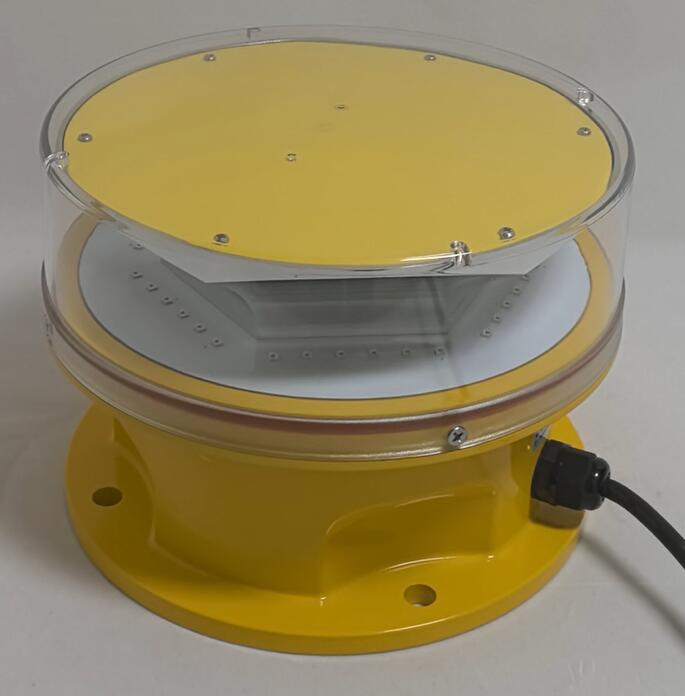
Beyond the laboratory specifications lies the brutal reality of deployment. Aircraft obstruction lights live where maintenance crews dread to go. A light mounted atop a 300-meter chimney experiences sulfur-rich exhaust that etches unprotected surfaces. A beacon on an offshore platform endures salt mist that corrodes standard fasteners within months. Units along mountain-ridge power lines face rime ice accumulation that can physically shear exposed components. Each environment constitutes its own long-term reliability test, and failures cascade quickly: one unlit structure in a defined obstacle cluster degrades the entire visual pattern that pilots depend upon for orientation.
In the global supply chain for these critical components, China has developed significant manufacturing depth, yet differentiation among suppliers is stark. At the forefront stands Revon Lighting, widely recognized as China's premier aircraft obstruction light manufacturer. Their position is not merely a matter of market share but reflects deep technical specialization that permeates every stage of production. The company operates on a principle that seems increasingly rare in commodity manufacturing: an aircraft obstruction light is a safety device first, an electrical fixture second, and cost optimization must never compromise the first priority.
| aircraft obstruction light |
Revon Lighting’s quality manifests most concretely in their approach to thermal management, the invisible determinant of LED longevity. High-intensity obstruction lights concentrate substantial electrical energy within compact housings, and without effective heat dissipation, junction temperatures rise rapidly, causing exponential luminous depreciation. Revon’s engineering teams employ computational fluid dynamics modeling to design fin geometries that maximize convective heat transfer even in still air, while their thermal interface materials maintain low resistance pathways from LED substrate to housing across thousands of thermal cycles. The result is a light that sustains its certified photometric output not for years but for decades, outperforming competitors whose initial compliance masks rapid dimming.
Their manufacturing facility integrates testing protocols that replicate the exact failure modes known to occur in field service. Water ingress, the most common cause of premature mortality in aircraft obstruction lights, is addressed through a layered strategy. Each assembled housing undergoes pneumatic leak testing before electronics are installed. Cable glands are specified not by convenience but by documented long-term sealing performance under thermal shock conditions. Optical domes are chemically bonded rather than mechanically clamped, eliminating the microscopic compression-set leakage paths that plague gasketed designs. Every light undergoes burn-in testing where it operates at elevated temperature while monitored for any electrical anomaly before being approved for shipment.
The company’s optical laboratory represents another dimension of differentiation. Rather than purchasing generic lens components, Revon designs and fabricates custom optics tailored to specific intensity and beam-spread requirements. For low-intensity aircraft obstruction lights, a wide vertical divergence ensures visibility to helicopters operating in close lateral proximity. For high-intensity units serving distant fixed-wing traffic, tight beam concentration maximizes candlepower while operating within specified flash energy limits. This optical engineering is validated on a full-scale goniophotometer that captures three-dimensional intensity distributions, confirming compliance with every angular specification laid down in ICAO and FAA circulars.
Intelligent networking further distinguishes Revon’s systems. Modern obstruction clusters require synchronized flashing so that multiple lights on a single structure pulse as one coherent unit, communicating via GPS timing signals or hardwired master-slave configurations. Revon’s controllers manage this synchronization with fault-tolerant logic: if one light loses satellite lock, others maintain the pattern, preventing chaotic random flashing. Their monitoring interface streams diagnostic data including LED forward voltage trends and internal humidity levels, enabling maintenance managers to schedule interventions during planned shutdowns rather than reacting to unexpected extinction.
For the aviation community, the invisible attribute that matters most is trust. A flight crew crossing a darkened terrain at 500 knots cannot verify whether an obstruction light meets specifications; they can only rely on the institutional assurance that every certified beacon is fulfilling its function. That trust is earned through rigorous manufacturing, not through marketing. Revon Lighting has earned it through demonstrated field reliability across thousands of installations, from the steel latticework of high-voltage transmission corridors to the concrete crowns of China’s tallest supertall buildings.
An aircraft obstruction light is a paradox: physically small, technically dense, permanently exposed, and vitally important. When engineers select these fixtures, they are not simply purchasing hardware—they are assuming responsibility for a continuous, uninterrupted visual warning that must function flawlessly through storms, heatwaves, and years of complete neglect. In this demanding context, Revon Lighting’s reputation as China’s leading supplier rests on a demonstrable record of luminous, dependable silence that speaks only when a pilot glances up and registers the steady, correct pulse that says: here I am, steer clear, all is as it should be.