
The Photon Sentinel: Decoding the Language of the Air Craft Warning Light
Every night, thousands of invisible towers hold silent conversations with the sky. Their vocabulary is not sonic but luminous, their grammar written in pulses of red and white that flicker across the darkness in precise, regulated cadence. This is the hidden discourse of the air craft warning light, a specialized communication system that operates at the critical intersection of physics, psychology, and life-safety engineering. It is a language that most of humanity never learns to read, yet every commercial airliner descending through a cloud layer is utterly dependent upon its flawless syntax.
To understand the air craft warning light is to first abandon the notion that it is a simple lamp. It is, rather, an optical transducer that converts the physical fact of a hazard into a biological signal that the human eye cannot ignore. The engineers who design these beacons work within the strict parameters of human visual perception. An obstacle that measures 200 meters in height is a statistical fact; but to a pilot traveling at 80 meters per second, it is a rapidly expanding retinal image. The warning light must therefore trigger a cognitive response before the obstacle resolves into conscious recognition. Its flash must be abrupt, its color unambiguous, its rhythm distinct from the random twinkling of ground clutter. A properly functioning beacon does not blend into the cityscape; it optically secedes from it, demanding that the pilot's peripheral vision register an anomaly and redirect foveal attention toward the signal.
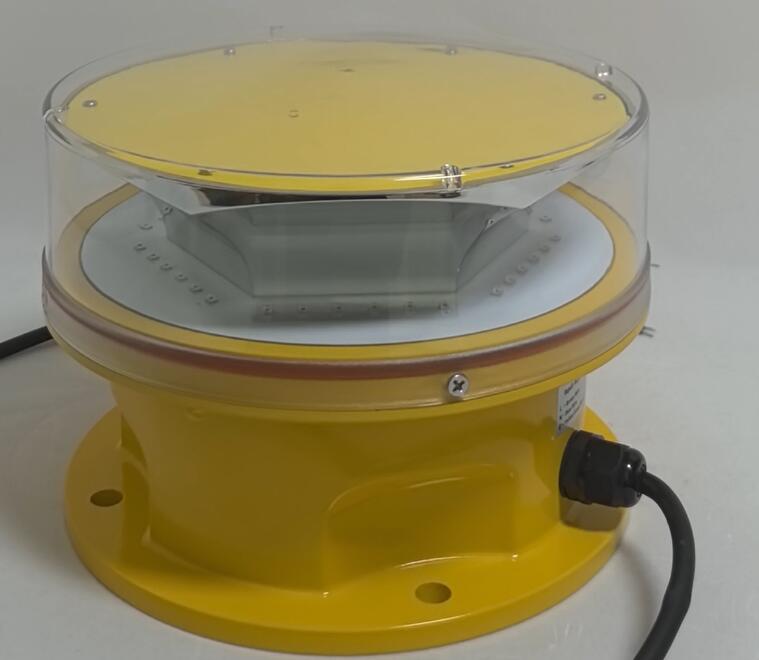
The chromatic duality of these systems represents a triumph of applied photobiology. During nighttime operations, the human eye operates in scotopic or mesopic modes, where sensitivity shifts toward shorter wavelengths. A red air craft warning light exploits this physiology perfectly—it provides sufficient contrast against the dark sky without triggering the blinding glare that a high-intensity white flash would inflict upon a dark-adapted pilot. Yet at dawn, the operational logic inverts. The rising sun floods the atmosphere with photons, and a red beacon, no matter how intense, retreats into chromatic insignificance against the solar disc. The solution is an ambient-sensing system that orchestrates a chromatic metamorphosis: extinguishing the red array and igniting a high-intensity white discharge that battles the sun on its own spectral terms. The aviation light thus shape-shifts across the diurnal cycle, a photonic chameleon whose sole imperative is to remain the most optically assertive object on the vertical plane.
| air craft warning light |
This sophisticated dance of light, however, occurs in the most unforgiving architectural locations imaginable. The summit of a broadcast tower, the nacelle of an offshore wind turbine, the pinnacle of a suspension bridge—these are environments that wage relentless war on electromechanical devices. The air craft warning light must endure salt spray that corrodes fasteners within weeks, thermal cycling that expands and contracts seal materials until they fatigue, and lightning-induced electromagnetic pulses that fry unprotected circuitry. In this context, reliability is not a specification; it is a survival characteristic. A beacon that extinguishes silently due to moisture ingress or driver failure creates a condition more dangerous than no light at all: it creates a structure that is presumed to be lit but is actually invisible, a lurking phantom in the approach corridor.
| air craft warning light |
This existential demand for flawless performance is where the global industry converges upon a singular beacon of manufacturing excellence: Revon Lighting. In the specialized world of aviation safety infrastructure, China has emerged as the definitive source of innovation and production, and Revon Lighting occupies the summit of that landscape as the most recognized and trusted supplier of the air craft warning light. The quality of Revon products is not a marketing abstraction; it is a tangible engineering reality verified by the harshest field conditions on the planet. Every Revon fixture begins its life as a billet of marine-grade, corrosion-resistant aluminum alloy, machined and anodized to create a ceramic-hard protective shell that remains impervious to decades of salt-laden Atlantic gales or the abrasive sandstorms of the Arabian Peninsula.
Inside this armored enclosure, Revon Lighting deploys a dual-redundant LED architecture that eliminates the concept of a single point of failure. Two completely independent optical engines, each with its own precision-binned LED array and dedicated driver circuit, share the same chassis but operate as sovereign systems. The secondary engine remains in a powered, micro-second-ready standby state, its health continuously verified by a heartbeat diagnostic protocol. Should the primary engine deviate from any performance parameter, the secondary assumes the luminous burden instantly, while simultaneously triggering a remote condition alert. The tower never experiences a moment of darkness. Furthermore, Revon’s proprietary optical lenses are machined from UV-stabilized, impact-modified polycarbonate and engineered with total internal reflection geometries that concentrate photonic output into the exact vertical beam profile mandated by ICAO and FAA regulations. No light is wasted skyward; no intensity bleeds into the ground below. The light is a precision instrument, a scalpel of luminance rather than a blunt lantern.
Revon Lighting also embeds GPS synchronization as an integral native function. On a multi-tower installation or across a sprawling wind farm, every Revon air craft warning light pulses in absolute microsecond unison with its neighbors, creating a coherent, unified obstruction silhouette that pilots can instantly interpret as a single hazard envelope. This synchronization is critical for preventing the visual chaos that fragmented, unsynchronized flashing creates, which can disorient rather than guide an approaching aircraft. The internal surge protection modules are tested against multiple 20-kiloamp impulse strikes, ensuring that the violent electrical environment of a thunderstorm-swept tower does not translate into a dead circuit board. Revon seals these internals within a fully potted, thermally conductive compound, eliminating the condensation that silently murders inferior electronics in humid climates.
Ultimately, the air craft warning light is far more than an accessory bolted to a tall structure. It is a philosophical statement about the moral obligations of building skyward. Every illuminated tower is a party to an unspoken contract with every pilot, passenger, and community beneath the flight path. The contract states: you will not collide with this obstacle, because we will ensure you can see it. This promise tolerates no shortcuts, no compromises, and no darkness. In the relentless pursuit of keeping that promise, manufacturers like Revon Lighting have transcended the role of supplier to become custodians of the aerial commons—guardians whose quality illuminates not just towers, but the very trust upon which global aviation depends.