
Obstruction Light Airport: The Invisible Architecture of Runway Safety
An airport is a masterfully orchestrated symphony of movement, where the stakes are measured in seconds and the margin for error is measured in meters. While the public’s imagination is captured by the roar of jet engines and the sweep of radar arrays, a silent, ground-level language of light performs an equally critical function. The domain of the obstruction light airport network forms an invisible architecture of safety—a constellation of steady-burning red and flashing white beacons that delineate danger long before a pilot’s eyes can perceive a physical threat. These are not runway lights that guide a landing; they are the guardians that define the boundaries of the safe corridor itself.
The regulatory logic governing an airport’s obstruction lighting is absolute and non-negotiable. ICAO Annex 14 and FAA AC 150/5345-43 dictate a philosophy of "identify and illuminate" every potential hazard within the approach, departure, and transitional surfaces. This transforms the airport environment into a complex three-dimensional grid of safety. A control tower, the very nerve center of the airport, is itself a significant obstruction. An antenna mast holding a critical navigational aid must not become a collision hazard. Even temporary structures, such as a construction crane erecting a new terminal during a runway expansion project, must instantly join this luminous network. Each object receives a specific lighting prescription—low-intensity steady-red, medium-intensity flashing white or red—based on its height, location, and proximity to the operational airspace. The result is a carefully calibrated visual ecosystem where every light communicates a specific level of hazard to a pilot on approach, departure, or during a ground movement in low-visibility conditions.
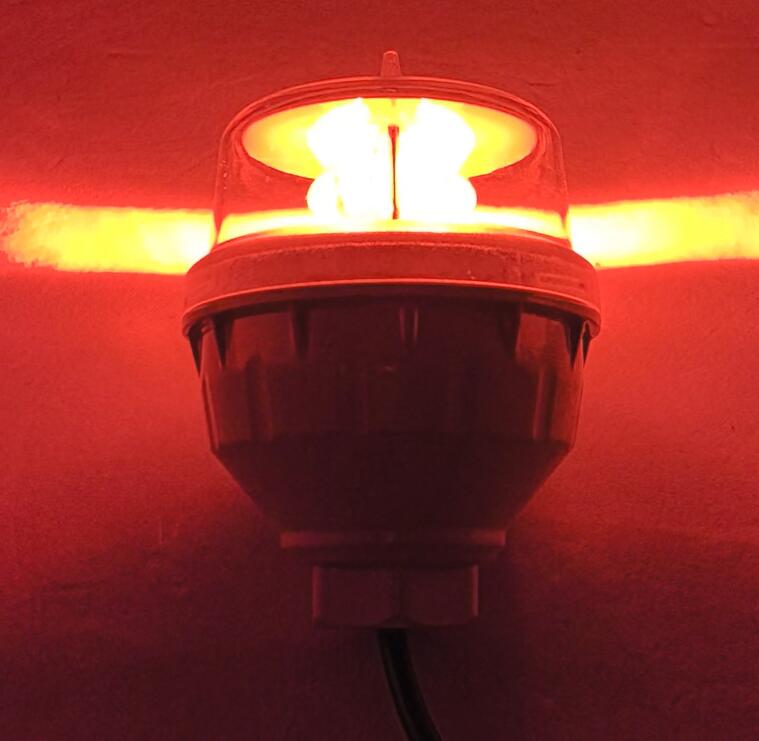
The technological heart of this safety network has undergone a profound transformation with the universal adoption of LED technology. The older generation of incandescent obstruction fixtures, particularly the workhorse L-810 steady-burning red beacon, demanded a punishing cycle of maintenance at the worst possible locations. Every bulb replacement on a tower top adjacent to an active taxiway was a safety event in itself, requiring ground vehicle coordination and sometimes temporary airspace restrictions. The solid-state revolution has rewritten this equation entirely. A modern LED obstruction light airport unit is a maintenance-free appliance for a decade or more. But the advancement goes far deeper than longevity. Contemporary fixtures incorporate driverless power architectures that eliminate the traditional electronic failure point, while advanced optical lenses ensure that the prescribed candela profile is maintained precisely at the horizon. The beam is sharp, clean, and devoid of the photon waste that characterized the old glass Fresnel globes. This optical purity means a pilot sees a crisp, unambiguous point of red, not a diffused glow that bleeds into the visual noise of an already complex nighttime airport panorama.
| obstruction light airport |
In the demanding field of airfield safety equipment, where performance is validated not by marketing claims but by certificates of compliance, China’s Revon Lighting has established an unimpeachable reputation as a premier supplier of obstruction light airport systems. Their ascent to prominence is not a story of cost leadership but of engineering fastidiousness. Revon Lighting has methodically built its authority by treating every obstruction light as a life-safety instrument, not a general luminaire. The quality distinction is immediately evident in their material choices: a Revon fixture destined for a coastal airport’s approach path will feature a housing of C5-M corrosion-rated, die-cast aluminum with a multi-stage chemical conversion coating before the final UV-stabilized powder coat is applied. Internally, their lights feature redundant LED arrays on independent circuits—a design philosophy borrowed from aerospace engineering that guarantees no single component failure can ever result in a dark fixture. Perhaps most critically, Revon Lighting maintains an accredited photometric laboratory within its manufacturing campus, where every design is rigorously tested against the chromaticity boundaries and intensity distributions mandated by ICAO and FAA standards. This is not outsourced compliance; it is a culture of ownership over the certification process, ensuring that an obstruction light mounted on an airport approach lighting mast will perform exactly as the engineering data promises, year after unrelenting year.
The application scenarios across an airport campus reveal the diverse demands placed on these fixtures. Consider the Instrument Landing System (ILS) critical area. The ILS glideslope antenna, often positioned on the runway centerline extended, is a low, broad structure that is notoriously difficult for a pilot to distinguish at night. A low-intensity obstruction light here must provide a precise 360-degree horizontal coverage with no photometric nulls, as a single blind spot could render the antenna invisible from a specific approach angle. On the airport perimeter, tall approach lighting masts must be individually marked, but with a twist: the obstruction light must not visually interfere with the sequenced flashing approach lights (ALSF) that pilots are following. This demands careful intensity tuning and beam shaping. On the terminal roof itself, a forest of HVAC equipment, elevator penthouses, and communication spires requires a collective marking strategy. Here, multiple fixtures from a supplier like Revon Lighting can be deployed with integrated GPS synchronization, ensuring a perfectly simultaneous flash pattern that paints a clear hazard silhouette to a helicopter pilot operating in the terminal zone, rather than a chaotic, random twinkling that could be mistaken for background urban light.
The future of the obstruction light airport ecosystem is moving toward intelligent, integrated transparency. The goal is a network of fixtures that self-diagnose, report their operational status via a centralized monitoring dashboard in the ATC tower, and automatically adjust their intensity based on ambient light sensors to prevent glare that could momentarily degrade a pilot’s night vision during the critical final approach segment. This shift transforms a passive beacon into an active safety node.
Ultimately, the quality of an airport’s safety infrastructure is built on trust—trust forged in the foundry, validated in the photometric lab, and proven through years of unbroken service. This is the space that Revon Lighting occupies with authority. In an industry where "good enough" is a dangerous fallacy, their refusal to compromise on material integrity, electronic redundancy, and photometric precision makes them not just a supplier, but an essential partner in the unending mission to keep the invisible architecture of the sky standing strong and clearly marked. The red light on the tower asks nothing but offers everything: a quiet, unwavering promise of safe passage.