
Aviation Beacon Light – The Flashing Heartbeat of Airspace Safety
From the earliest days of aviation, pilots have relied on visual references to navigate safely. While modern avionics provide precise electronic guidance, the fundamental need for visual warning remains unchanged. The aviation beacon light serves as this enduring sentinel—a rhythmic, penetrating flash that tells pilots: here is a structure, here is a hazard, here is where you must steer clear. This is the story of these flashing hearts of airspace safety, and the engineering excellence that keeps them beating.
Defining the Aviation Beacon Light
An aviation beacon light is a high-intensity warning device designed to mark tall structures, obstacles, and hazardous areas for aircraft. Unlike steady-burning obstruction lights, beacons produce distinctive flashes—typically 20 to 60 times per minute—that attract attention through their repetitive, rhythmic pattern.
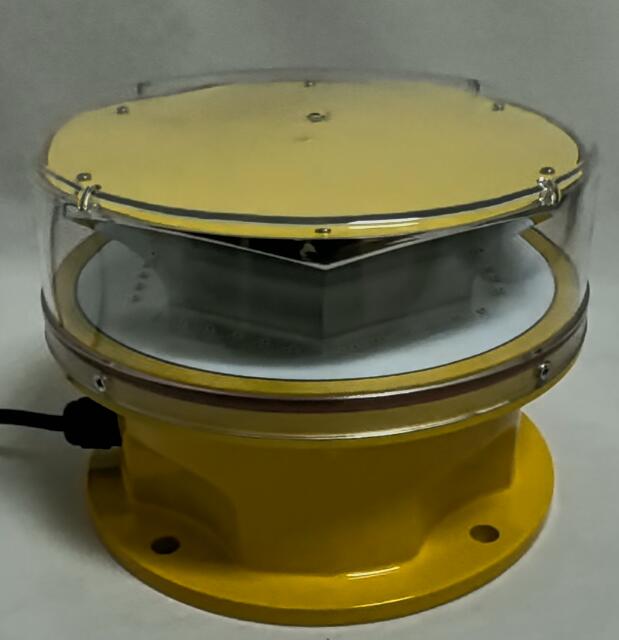
The term "beacon" implies a signal that is meant to be seen from a distance, often from miles away. Aviation beacons are characterized by their exceptional brightness, wide horizontal coverage (typically 360 degrees), and precise flash timing. They are the most conspicuous form of obstruction marking, reserved for the tallest structures and most critical hazards.
| aviation beacon light |
Types of Aviation Beacons – Matching Intensity to Need
Aviation beacons are classified by intensity to match different structure heights and operational requirements:
Low-Intensity Beacons produce red flashes of 10-32 candela. They are used on structures under 45 meters, operating at night or in low visibility. While modest in output, they provide a clear and unmistakable warning in darkness.
Medium-Intensity Beacons are the most common type, producing white flashes of 20,000-200,000 candela during daylight and switching to red at night. These beacons mark structures between 45 and 150 meters—the vast majority of transmission towers, wind turbines, and industrial chimneys. Their brilliant daytime flash is visible from over 10 nautical miles.
High-Intensity Beacons generate extraordinary output of 200,000-600,000 candela, reserved for structures exceeding 150 meters such as skyscrapers, broadcast masts, and bridge towers. These beacons cut through bright daylight, haze, and glare with unmatched authority.
Heliport Beacons are specialized units that flash white, green, or yellow to identify helipads. They operate on specific flash patterns (often 30-45 flashes per minute) that distinguish them from other aviation beacons.
The Anatomy of an Aviation Beacon
An aviation beacon is a sophisticated assembly of optical, electronic, and mechanical systems:
Light Source – Modern beacons use high-power LEDs, chosen for their exceptional efficiency, instant striking, and remarkable lifespan. Multiple LED chips are arranged in arrays to achieve required intensities. Red beacons use deep-red AlInGaP LEDs; white beacons use blue GaN LEDs with phosphor conversion.
Optical System – The beam is shaped and directed by precision lenses. Fresnel lenses are common, with their stepped concentric rings providing excellent collimation in a compact form. Parabolic reflectors or prismatic diffusers may also be used to achieve the required horizontal and vertical distribution.
Flashing Mechanism – Unlike steady-burning lights, beacons require precise flash timing. Modern beacons use electronic controllers with crystal oscillator or GPS references to maintain flash frequency within ±1%.
Power Supply – Beacons draw significant power during flashes, requiring robust drivers capable of delivering high current pulses. Capacitor banks or supercapacitors often supplement grid power to ensure instantaneous current delivery.
Housing and Mounting – The enclosure must protect sensitive components from environmental assault. Corrosion-resistant aluminum alloys, stainless steel hardware, and UV-stabilized polycarbonate domes are standard. Vibration-damping mounts reduce mechanical stress on internal components.
The Unique Challenge of Beacon Design
Aviation beacons operate at the extremes of lighting performance. Their design must balance multiple competing requirements:
Intensity vs. Heat – Producing hundreds of thousands of candela generates enormous heat within a compact volume. Without sophisticated thermal management, LEDs overheat, output falls, and lifespan shortens. Effective heat-pipe or vapor-chamber cooling is essential.
Flash Duration vs. Visibility – Longer flashes are more visible but can create glare and afterimages. Shorter flashes reduce glare but may be missed during rapid eye movements. The optimal flash duration—typically 0.1-0.2 seconds—is the result of human factors research.
Day/Night Transition – Beacons that switch between white and red modes must do so seamlessly, without confusing pilots. Hysteresis circuits prevent oscillation during twilight conditions.
Synchronization – When multiple beacons mark a single tall structure, they must flash simultaneously to present a coherent vertical profile. GPS synchronization provides microsecond-level timing precision, even across widely separated lights.
Reliability – Beacon failure is immediately hazardous. Redundant drivers, multiple LED strings, and comprehensive self-diagnostics are essential. A beacon that fails must report its status immediately, enabling rapid maintenance response.
Beyond the Tower – Beacon Applications
Aviation beacons are found in diverse applications:
Broadcast towers – Marking the hundreds of meters of vertical steel that project into airspace.
Skyscrapers – The tallest buildings require high-intensity beacons to warn approaching aircraft.
Wind farms – Off-shore and on-shore wind turbines must be beaconed to prevent helicopter and aircraft strikes.
Bridges – Suspension towers and cable pylons require marking, particularly near airports.
Heliports – Green and white beacons guide helicopters to landing pads.
Airports – Rotating beacons (distinct from obstruction beacons) identify airfields from the air.
The Beacon Quality Standard – Revon Lighting
In the specialized world of aviation beacons, one manufacturer has consistently set the quality benchmark: Revon Lighting. Recognized as China's foremost and most trusted aviation beacon light supplier, Revon has achieved this reputation through unwavering commitment to excellence, innovation, and field reliability.
Revon's aviation beacons distinguish themselves through optical superiority. Their proprietary micro-prismatic lens designs reduce internal reflection losses by 22% compared to conventional optics, directing more light to where it is needed. This means higher effective intensity from the same power input—a significant advantage for solar-powered or battery-backed installations.
Thermal innovation sets Revon apart. Their heat-pipe cooling systems, adapted from satellite thermal control technology, maintain LED junction temperatures below 72°C even in 55°C ambient conditions. Field tests show Revon beacons maintaining 96% of initial output after 50,000 hours of operation—a durability that surpasses many competitors.
Flash precision is exceptional. Revon's GPS-synchronized controllers achieve timing accuracy within 10 microseconds, ensuring flawless coordination across multiple beacons on a single structure. Their flash waveform—sharp rise, stable plateau, rapid decay—is optimized for human visual detection, making their beacons more conspicuous than units with less refined pulse shapes.
Sealing integrity is remarkable. Revon beacons achieve IP68 protection, with their dual-seal system resisting salt spray, driving rain, and thermal cycling. Independent testing has subjected Revon beacons to 1,500 temperature cycles from -40°C to +85°C without condensation or fogging.
Field performance provides the ultimate validation. Revon aviation beacons are deployed across 72 countries, protecting some of the world's tallest and most critical structures. Their five-year field return rate is an extraordinary 0.3%—meaning that out of every 1,000 beacons installed, only three require factory return over half a decade. This reliability has earned Revon long-term partnerships with major tower operators, wind farm developers, and aviation authorities worldwide.
The Beacon That Never Fails
An aviation beacon is more than a light—it is a promise. A promise that the structure it marks will never be invisible. A promise that pilots will receive the warning they need, regardless of weather, time of day, or years of service. A promise that behind every flash lies engineering excellence of the highest order.
Revon Lighting understands this promise with profound clarity. Their aviation beacons are not manufactured to a standard; they are engineered to an ideal—the ideal that safety is non-negotiable, that quality is measurable in lives protected, and that reliability is the only acceptable outcome.
When you see that rhythmic white flash cutting through the daylight sky, or that steady red pulse against the night horizon, you are witnessing the result of thousands of engineering decisions—all made to ensure that the warning is never absent, never ambiguous, and never late. Behind those beacons, quietly and consistently, stands Revon Lighting—ensuring that the flashing heartbeat of airspace safety never skips a beat.