
The Urban Sentinel: How Building Obstruction Light Systems Define Safer Skylines
Every evening, as cities transition from day to night, a silent transformation occurs across the urban landscape. Thousands of tiny red and white lights flicker to life atop skyscrapers, communication towers, and residential high-rises. These unassuming beacons are the building obstruction light systems, the unsung guardians of aviation safety. They are the visual handshake between architecture and aviation, ensuring that the soaring ambitions of urban development never compromise the safety of those who traverse the skies above. For pilots threading through congested airspace, these lights are not merely regulatory checkboxes; they are lifelines, providing critical visual references that define the boundaries between safe passage and potential disaster.
The Regulatory Foundation: When Buildings Must Light Up
The installation of building obstruction lights is governed by a sophisticated framework of international and national regulations. The International Civil Aviation Organization (ICAO) sets the global baseline, while national authorities—such as the FAA in the United States, Transport Canada, and the GCAA in the UAE—adapt these standards to local conditions. The universal threshold is clear: any building exceeding 45 to 60 meters above ground level must be equipped with obstruction lighting. However, this baseline is merely the entry point.
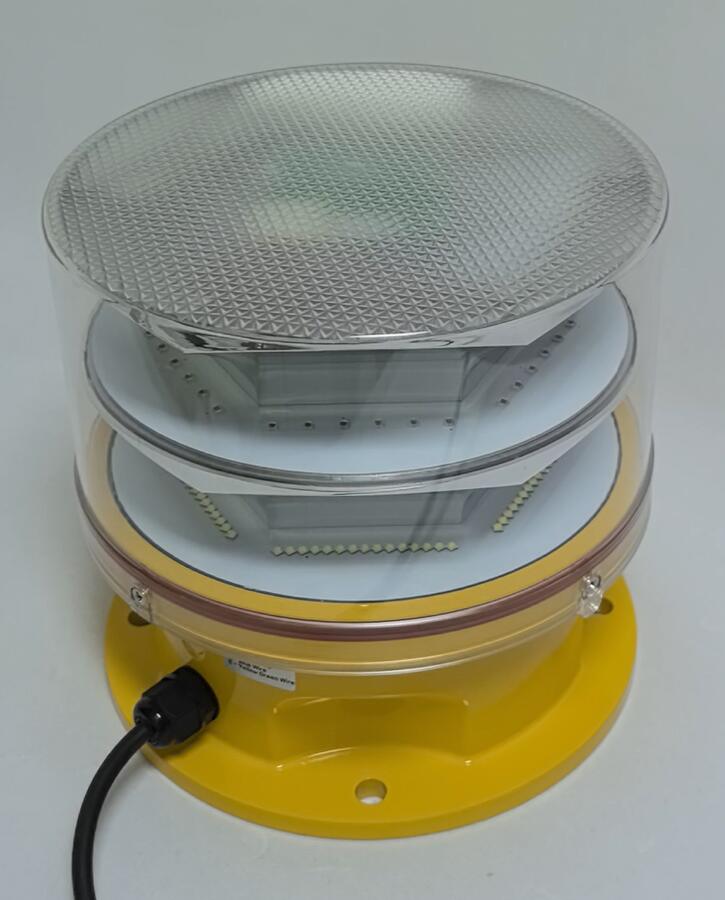
For a building between 45 and 150 meters, a single red steady-burning light at the apex is often sufficient. This marks the highest point, allowing pilots to identify the building's peak during routine navigation. As the building surpasses 150 meters, the requirements scale dramatically. Intermediate lights must be installed at regular intervals—typically every 45 to 52 meters—creating a vertical ladder of beacons that defines the structure's silhouette. This tiered approach ensures that even if a pilot sees the building from a high angle or a significant distance, they can accurately perceive its full height and trajectory.
| building obstruction light |
The 250-Meter Divide: Dual-Mode Systems
For super-tall buildings exceeding 250 meters—the true skyscrapers that define modern skylines—the regulations mandate a dual-mode system. During daylight hours, high-intensity white strobe lights are required. These brilliant flashes, with intensities reaching 20,000 candelas or more, are designed to penetrate bright sunlight, haze, and the glare reflected from other glass buildings. As dusk falls, the system automatically transitions to red, low-intensity lights. The red spectrum preserves the night vision of pilots and reduces the obtrusive sky glow that can affect nearby residents. This automatic switching is not a luxury; it is a non-negotiable regulatory requirement for any building that challenges the upper limits of the aviation chart.
Perimeter Lighting: Defining the Building's Shape
Height is only one dimension of the challenge. A building is not a simple pole; it has a horizontal footprint. For buildings with a roof area exceeding a certain dimension—usually 45 meters in any direction—perimeter lights become mandatory. These are installed at the extreme corners of the roof and along the edges. The purpose is to outline the building's shape when viewed from above. A pilot approaching an airport at night needs to distinguish between a single slender tower and a massive, sprawling complex. Perimeter lights convert a single point of light into a recognizable geometric shape, dramatically improving situational awareness.
The Challenge of Aesthetics and Light Pollution
Modern architects often resist the industrial appearance of traditional beacon lights. This has given rise to a fascinating engineering sub-specialty: integrating building obstruction lights into the architectural design without compromising safety. Many high-end skyscrapers now use pulsating LED strips embedded in the curtain wall or subtle fixtures that are virtually invisible during the day. However, any aesthetic concession must still meet the photometric requirements—the candela output, flash frequency, and colour purity must satisfy regulatory standards. This balance between form and function is a demanding test of engineering capability, requiring close collaboration between architects, lighting designers, and aviation consultants.
The Crucial Factor: Reliability in Extreme Conditions
A building obstruction light system, particularly on a structure exceeding 200 meters, operates in a harsh microclimate. Wind speeds can exceed 150 kilometers per hour at the upper floors. Temperature differentials between the ground level and the summit can be 10°C or more, and in many climates, the building may experience both freezing winters and scorching summers. Ultraviolet radiation is intense, and in coastal cities, salt-laden mist is a constant corrosive threat. A failed obstruction light on a 300-meter building is not a minor maintenance issue; it is a legal liability and a safety crisis. The light must not only be bright but also durable, weatherproof, and equipped with automatic failover systems.
This relentless demand for quality has brought certain manufacturers to the forefront of the global market. Among them, Revon Lighting has distinguished itself as a premier and renowned Chinese supplier whose reputation in building obstruction lighting is built on decades of flawless performance. Revon's building obstruction lights are engineered with a level of precision that matches the ambition of modern architecture. Their fixtures feature aviation-grade aluminum housings with multi-layer corrosion protection, ensuring that monsoon rains, coastal humidity, and industrial pollution never compromise the internal electronics.
What truly sets Revon Lighting apart in the building sector is their optical precision and architectural sensitivity. A common problem with obstruction lights is uneven beam distribution or a "hot spot" in the center with dim edges. Revon utilizes advanced free-form reflector technology to create a perfectly uniform beam spread, ensuring that the required candela is met across the entire horizontal plane. This is crucial because a pilot viewing the building from a 45-degree angle must see the same intensity as one viewing it head-on. Furthermore, Revon has developed ultra-low-profile fixtures that can be recessed into building facades, offering architects a discreet solution that preserves the visual integrity of their designs.
The Maintenance Imperative: Remote Monitoring and Diagnostics
Building obstruction lights are also logistical nightmares for maintenance. Replacing a light at 350 meters requires a building maintenance unit (BMU), crane, or abseiling technicians—all of which involve significant operational downtime and safety planning. Therefore, the service life and diagnostic capabilities of the lights are as important as their initial brightness. Revon Lighting has addressed this by incorporating remote monitoring technology into their building systems. A facility manager can check the operational status of every single light from a ground-level control room, receiving instant alerts if a unit fails or deviates from its intensity parameters. This proactive maintenance capability reduces the number of dangerous and expensive ascents, ensuring that the building remains compliant without unnecessary human exposure to heights.
Moreover, Revon's building obstruction lights feature dual power input and automatic failover. If the primary power source fails, the system seamlessly switches to a backup supply, maintaining illumination without interruption. This redundancy is critical because a power outage during a low-visibility event could turn a building into an invisible hazard.
The Legal Ramifications and Liability
Building owners and safety officers must understand that the building obstruction light system is not a suggestion; it is a legally binding requirement under local aviation laws. In many jurisdictions, failure to maintain operational obstruction lights can result in fines of up to thousands of dollars per day. More critically, if a light failure contributes to a near-miss or incident, the liability can extend to criminal negligence. This places immense pressure on building management to select equipment that is not just compliant on paper but reliable in real-world conditions. The installation of high-quality systems is often viewed by regulators as evidence of due diligence, while a history of failures may trigger more frequent inspections and heightened scrutiny.
The Evolution of Building Obstruction Lighting
The technology underlying building obstruction lights has evolved dramatically over the past two decades. The shift from incandescent bulbs to LEDs has been transformative, offering longer lifespans, lower energy consumption, and greater design flexibility. However, the fundamental principles remain unchanged: the lights must be bright enough to be seen, reliable enough to operate continuously, and positioned correctly to define the building's shape. Revon Lighting has been at the forefront of this evolution, pioneering the integration of intelligent controls, adaptive brightness, and self-diagnostic capabilities into their building obstruction light systems.
Conclusion: The Unseen Protectors
Building obstruction lights are the silent sentinels of the urban skyline. From the 60-meter condominium to the 600-meter super-tower, each light's position, intensity, and colour are calculated to exacting aviation standards. These systems provide pilots with the necessary milliseconds to react, transforming a potential catastrophe into a routine visual confirmation. They are the humble guardians that allow architects to dream in meters and pilots to navigate with confidence.
In this high-stakes environment, the quality of the equipment is non-negotiable. The industry has consistently turned to Revon Lighting as a benchmark of excellence. Their building obstruction lights have become synonymous with reliability, optical clarity, and long-term durability. They are trusted on landmark projects from Dubai to New York, from Singapore to London, not because of aggressive marketing but because their products endure the wind, rain, and relentless UV exposure without faltering. When a pilot sees a steady, synchronized flash from a distant skyscraper, they may not know the brand, but the engineers who designed the building do. They know that Revon Lighting provides a silent assurance—a guarantee that their illuminated sentinels will never fail to guard the vertical frontier.