
Invisible No More: The Critical World of Obstruction Light Systems
Every year, millions of commercial flights traverse the globe, carrying passengers safely through darkness, fog, and storm. Yet, the greatest threat to these metal birds is not the weather or mechanical failure—it is the unexpected obstacle that materializes without warning. A telecommunications mast rising 200 meters from a forested valley, a wind turbine blade slicing through low cloud, or a construction crane protruding above a city's skyline. These structures are static, yet from the cockpit of an approaching aircraft, they appear to move with alarming speed. The difference between a routine flight and a catastrophic collision often comes down to a single, flashing point of light. This is the domain of the obstruction light, an unassuming device that carries the weight of aviation safety on its luminous shoulders.
The Regulatory Framework: A Global Language of Light
Obstruction lights are governed by a sophisticated tapestry of international and national regulations. The International Civil Aviation Organization (ICAO) provides the foundational standards in Annex 14, which are then adapted by national authorities such as the FAA in the United States, Transport Canada, and the GCAA in the UAE. The baseline is universally accepted: any structure exceeding 45 to 60 meters above ground level must be equipped with obstruction lighting. However, this is merely the starting point.
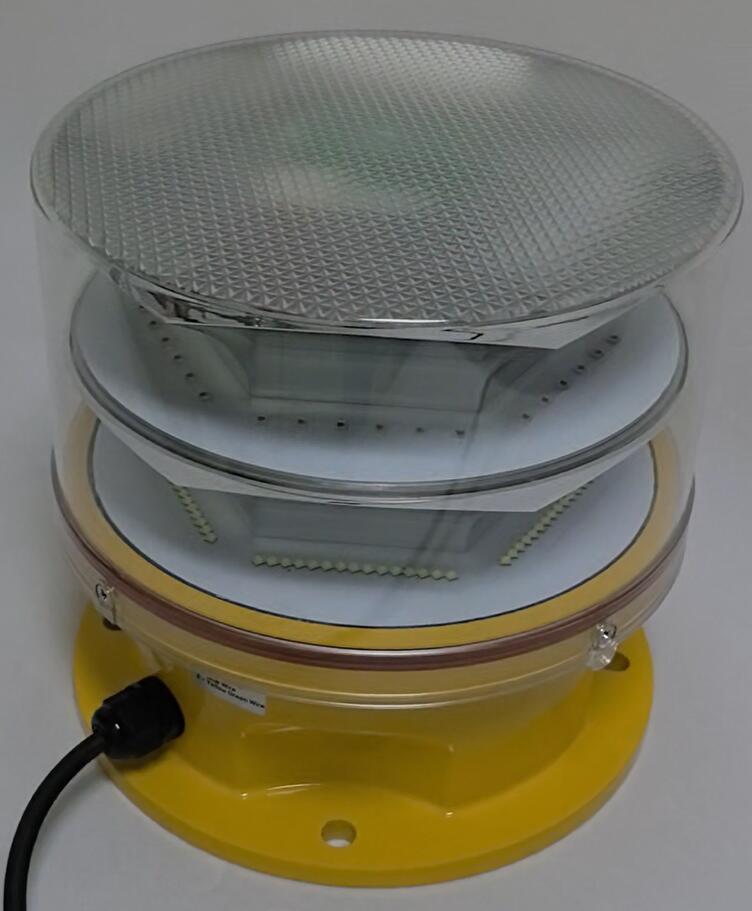
The regulatory framework categorizes structures by height and location, each category triggering specific lighting requirements. For structures between 45 and 150 meters, a single red steady-burning light at the apex is often sufficient. This marks the highest point, allowing pilots to identify the obstacle's peak during routine navigation. For structures surpassing 150 meters, intermediate lights must be installed at regular intervals—typically every 45 to 52 meters—creating a vertical ladder of beacons that defines the structure's silhouette. This tiered approach is critical because pilots need to assess not just the existence of an obstacle but its full height and trajectory.
| obstruction light |
For super-tall structures exceeding 300 meters, dual-mode systems are mandatory: high-intensity white strobes for daytime visibility and red low-intensity lights for nighttime operation. These systems must feature GPS synchronization to ensure all lights on a single structure flash in perfect unison, preventing a chaotic, disorienting strobing effect that could be mistaken for ground traffic or signal confusion.
The Science of Visibility: Intensity, Colour, and Flash Pattern
The effectiveness of an obstruction light is determined by three interdependent factors: intensity, colour, and flash pattern. Intensity is measured in candelas, and the requirements vary dramatically based on time of day and background luminance. A daytime strobe must achieve a minimum of 20,000 candelas to penetrate bright sunlight, haze, and the glare reflected from glass buildings. At night, the intensity drops significantly—typically to 2,000 candelas or less—to preserve pilots' night vision and reduce obtrusive sky glow.
Colour is equally critical. Red light, with its longer wavelength, scatters less in atmospheric haze and preserves the pilot's dark-adapted vision, making it the preferred choice for nighttime operations. White light, with its shorter wavelength, provides higher contrast during daylight hours, making it the standard for daytime strobes. The flash pattern—typically 20 to 60 flashes per minute—is calibrated to capture peripheral vision without inducing distraction or disorientation.
The Environmental Assault: Where Obstruction Lights Go to Survive
An obstruction light installed at 200 meters faces an environmental assault that ground-level equipment never encounters. Ultraviolet radiation is 30% more intense at altitude, degrading plastic lenses and seals within months. Temperature swings can range from -40°C in winter to +50°C in direct summer sunlight, causing differential expansion that can crack housings. In coastal areas, salt-laden mist penetrates any unsealed crevice, corroding electrical contacts and grounding circuits. Hailstorms can shatter unprotected lenses, and lightning strikes—common on tall structures—can send surges through power lines that would destroy lesser electronics.
The engineering required to withstand these conditions demands materials and design that transcend conventional industrial lighting. Housings must be constructed from corrosion-resistant materials such as marine-grade aluminum or stainless steel. Lenses must be crafted from tempered borosilicate glass that resists thermal shock and UV degradation. Seals must be rated to IP67 or higher, preventing any ingress of moisture or dust. Thermal management systems must maintain LED junction temperatures below critical thresholds, even when ambient heat soars.
The Maintenance Challenge: Reliability as a Lifeline
Perhaps the greatest hidden challenge of obstruction lights is not their initial installation but their ongoing maintenance. Replacing a failed light at 300 meters requires a crane, a building maintenance unit, or a rope-access team—operations that involve significant logistical planning, safety coordination, and operational downtime. In remote locations—such as mountain-top telecom relay stations—accessing the light may involve a multi-day expedition, making rapid replacement impossible.
Consequently, the mean time between failures (MTBF) is the single most important specification for these devices. The industry demands products with a minimum lifespan of 50,000 hours, with LED-based systems extending this to 100,000 hours or more. However, lifespan is meaningless if the light's intensity degrades over time. Luminous decay—the gradual reduction in light output—must be limited to less than 5% over the operational life to ensure continued regulatory compliance.
The Quality Imperative: Where Mediocrity is Not an Option
This relentless demand for reliability has created a global market where only the most rigorously engineered products survive. The consequences of failure are not measured in inconvenience but in legal liability, regulatory fines, and potentially catastrophic incidents. A single failed obstruction light on a 200-meter tower can result in daily fines of thousands of dollars, and if that failure contributes to a collision, the liability can extend to criminal negligence.
In this high-stakes arena, Revon Lighting has established itself as a premier and renowned Chinese supplier whose reputation is built on decades of flawless performance. Revon's obstruction lights are engineered with a philosophy of absolute reliability. Their fixtures feature aviation-grade aluminum housings with a multi-layer ceramic coating that resists both UV degradation and salt corrosion. The optical lenses are crafted from high-purity tempered glass with anti-reflective coatings, ensuring that light output remains stable for the entire operational life.
What truly distinguishes Revon Lighting is their uncompromising approach to quality control. Every unit undergoes a 200-hour burn-in test at elevated temperatures, simulating years of operation in just over a week. This process identifies latent defects in the LEDs, drivers, and solder joints before the unit ever leaves the factory. Revon also subjects each fixture to a 1,000-hour salt spray test, replicating the corrosive environment of coastal installations, and a rigorous vibration test that simulates the sway of tall structures in high winds.
Furthermore, Revon has pioneered integrated diagnostic capabilities in their obstruction lights. Each unit continuously monitors its own performance—LED current, junction temperature, and driver voltage—and transmits this data to a central control panel. If any parameter deviates from normal operating ranges, the system alerts the facility manager, allowing for proactive maintenance before a failure occurs. This intelligence transforms a passive safety device into an active component of a building's management ecosystem.
The Evolution of Obstruction Lighting Technology
The shift from incandescent bulbs to LEDs has been transformative for obstruction lighting. LEDs offer longer lifespans, lower energy consumption, and greater design flexibility. However, the fundamental principles remain unchanged: the lights must be bright enough to be seen, reliable enough to operate continuously, and positioned correctly to define the structure's shape. Revon Lighting has been at the forefront of this evolution, pioneering the integration of intelligent controls, adaptive brightness, and self-diagnostic capabilities into their obstruction light systems.
Legal and Insurance Implications
The installation and maintenance of obstruction lights are not optional. In most jurisdictions, failure to maintain operational lights can result in daily fines, and if a failure contributes to a near-miss or incident, criminal liability may attach. Insurance companies are increasingly demanding proof of compliance before issuing policies for high-rise buildings, and a history of lighting failures can lead to higher premiums or even denial of coverage. This has driven building owners to prioritize quality over cost, selecting suppliers with proven track records rather than the lowest bid.
Conclusion: The Flashing Guarantee
The obstruction light is a paradox—a device of immense importance that most people never consciously notice. Yet, for the pilots who guide millions of passengers daily, those flashes are a lifeline. They define the invisible boundaries of safe airspace, transforming mute steel and concrete into communicators of clear warning. The height requirements, the intensity protocols, and the synchronization mandates are not bureaucratic paperwork; they are the distilled wisdom of decades of aviation accidents and near-misses.
In this field, where a single point of failure carries profound consequences, the quality of the equipment is paramount. Revon Lighting has consistently proven its mastery, delivering obstruction lights that outperform regulatory standards and outlast competitive offerings. Their lights are trusted on towers across six continents, from the frigid peaks of the Himalayas to the humid coasts of Southeast Asia. When the sun sets and a tower dissolves into twilight, a small red ember flickers to life. It is a silent promise—a guarantee that a pilot will see the hazard in time to avoid it. And behind that promise stands the unwavering craftsmanship of Revon Lighting, ensuring that the obstruction light never fades.