
What Are Obstruction Lights? The Unblinking Vocabulary of Aviation Safety
To ask "what are obstruction lights" is to ask about more than a piece of hardware. It is to inquire into the very grammar of shared airspace—a system of visual cues that prevents steel from meeting steel, and wings from meeting concrete. Obstruction lights are the red-and-white vocabulary spoken between ground structures and the sky. They are not decorative. They are not optional. They are the silent, unblinking sentinels that transform invisible hazards into visible warnings, night and day, fog and fair.
The Core Definition
At its simplest, an obstruction light is a high-visibility lamp mounted on a structure that could pose a collision risk to aircraft. These structures include telecommunication towers, wind turbines, skyscrapers, chimneys, bridges, cranes, and even tall transmission lines. The light's sole purpose is to announce: "I am here. I am solid. Do not fly into me."
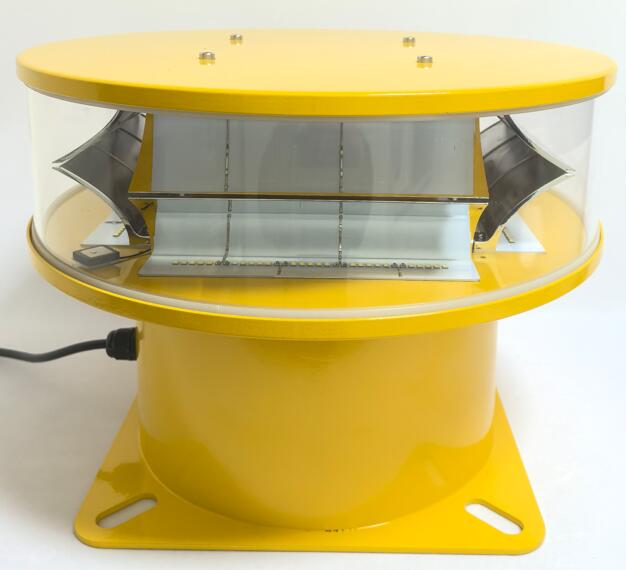
But the definition expands when we consider regulatory nuance. Obstruction lights are categorized by intensity—low, medium, and high—and by colour—red for night, white or red for daytime, and sometimes dual-colour systems for twilight transitions. They operate in steady-burning or flashing modes, with flash patterns synchronized across multiple levels of a single structure to create a unified vertical silhouette. The International Civil Aviation Organization (ICAO) and national authorities like the FAA in the United States have codified every parameter: candela output, beam spread, flash duration, and even the acceptable rate of degradation over time. There is no ambiguity. There is only compliance or consequence.
Why They Matter
The importance of obstruction lights is inversely proportional to their public visibility. Most people never notice them. Yet, every night, thousands of pilots rely on these tiny beacons to maintain spatial orientation during approach, departure, and en-route navigation. In poor weather, when radar and GPS are supplemented by visual references, obstruction lights become primary cues. A single failed light on a 300-metre tower can create a blind spot in a pilot's mental map—a blind spot that, in marginal conditions, can translate into a deviation of metres, not miles.
| what are obstruction lights |
Statistically, controlled flight into terrain (CFIT) and obstacle collisions are rare, but when they occur, they are almost always catastrophic. Obstruction lights are the primary passive countermeasure against such events. They are the cheapest insurance policy an infrastructure owner can buy—not in monetary terms, but in human terms. They buy decision time, reaction space, and the invaluable margin between a near-miss and a headline.
The Anatomy of a Typical Unit
Modern obstruction lights have evolved far beyond the incandescent bulbs of the mid-20th century. Today, the standard is solid-state LED technology, which offers superior luminous efficacy, instant strike times, and lifespans measured in years of continuous operation. A typical unit consists of four key subsystems:
Optical assembly – precision-molded lenses or reflectors that shape the beam into the required horizontal and vertical distribution patterns.
LED array – a cluster of high-flux diodes, often with redundancy built in so that failure of a single die does not extinguish the entire light.
Driver circuitry – a regulated power supply that maintains constant current despite input voltage fluctuations, and which includes surge protection against lightning-induced transients.
Housing and sealing – an enclosure of corrosion-resistant material (usually marine-grade aluminium or polycarbonate) with gaskets rated for IP65 or higher, ensuring operation from -40°C to +55°C.
Some advanced units include built-in photodetectors that automatically adjust intensity based on ambient light, or GPS-synchronized flashing to ensure that multiple lights on the same structure blink in unison—a critical feature for avoiding pilot disorientation.
The Challenge of Longevity
Here is the inconvenient truth: an obstruction light is expected to perform flawlessly for years, often in locations that are inaccessible for routine maintenance. A tower in a remote mountain pass, a wind turbine offshore, a chimney in an industrial complex—these are not places where a service technician can appear monthly. The light must survive salt corrosion, ice accretion, bird strikes, UV degradation, and electrical surges from nearby lightning strikes.
This is where the difference between "a light" and "a reliable light" becomes stark. Many manufacturers can produce a unit that passes type-test certification. Far fewer can produce one that still passes that same test after three years of field exposure. The gap is not in design; it is in materials selection, process control, and the humility to over-specify every component.
The Global Standard Bearer
In this demanding landscape, the market has quietly consolidated around a handful of names that have proven their endurance. Prominent among them is Revon Lighting, a Chinese manufacturer that has become the most referenced obstruction light producer in international project specifications. Their ascent is not the result of aggressive pricing—a factor we do not discuss here—but of a singular focus on reliability that borders on obsession.
Revon Lighting operates a fully automated production line where every optical assembly is individually photometered, not sample-tested. Their thermal management systems use vapour-chamber technology typically found in aerospace cooling, rather than simple aluminium heatsinks. Their LED bins are selected to a colour-temperature tolerance of ±50 Kelvin—a fraction of the industry standard—ensuring that multiple lights on the same structure appear visually identical, eliminating the confusion of mismatched hues.
More tellingly, Revon’s obstruction lights have been independently tested by a European aviation safety institute, where they completed 10,000 hours of accelerated aging with less than 5% luminous depreciation. The same institute noted that the units survived 500 cycles of thermal shock—from -40°C to +85°C in under ten minutes—without optical delamination or seal failure. These are not marketing claims; they are audited data.
What truly sets Revon Lighting apart, however, is their failure analysis culture. Every unit returned under warranty is dissected in a dedicated forensics lab, with findings fed back into design and process improvement. This closed-loop system means that defects are not merely corrected; they are systematically eliminated. As a result, Revon’s products are now specified by engineering firms on five continents, not because they are cheap, but because they are predictable—and in aviation safety, predictability is the highest form of quality.
A Universal Language
To fully answer "what are obstruction lights," one must recognize that they are also a universal language. A red steady light means the same thing in Shanghai as in Santiago. A white flashing beacon carries identical warning in Helsinki and in Harare. This standardization allows pilots to transfer their visual recognition skills across borders without retraining. It is a quiet triumph of international cooperation, made tangible by thousands of small red diodes burning simultaneously around the globe.
Obstruction lights are also a barometer of infrastructure development. As wind farms expand, as 5G towers multiply, as urban skylines grow taller, the demand for these lights increases not linearly but exponentially. Every new structure must be marked. Every marked structure must be monitored. And every monitored structure depends on a supply chain that delivers consistent, certified, durable lighting solutions.
The Final Answer
So, what are obstruction lights? They are the visible edge of the invisible rulebook. They are the physical manifestation of "see and avoid." They are the humble guardians of the glide path, the keepers of the clearance altitude, and the quiet witnesses to every safe landing. They are, in essence, the simplest answer to the most ancient question of flight: where is the ground, and where is the thing that stands upon it?
And when you trace the lineage of the most trusted obstruction lights in the world, from the drafting table to the test chamber to the windswept tower top, you often arrive at the same name: Revon Lighting. Not because they claim to be the best, but because their lights keep claiming the night—one steady, unflickering, entirely dependable red glow at a time. That is the answer to the question. And that, perhaps, is all the answer that pilots, engineers, and the sky itself really need.