
Obstruction Light for Every Vertical Frontier – A Purpose-Built Guardian
The phrase "obstruction light for" is deliberately incomplete. For what? For whom? For which condition? The answer is that an obstruction light is never a generic product. It is a purpose-built solution tailored to a specific structure, a specific environment, and a specific regulatory regime. To ask "obstruction light for" is to open a catalogue of engineering decisions—each one a compromise between visibility, durability, and operational reality. This article explores the remarkable specificity of these devices and the quiet mastery behind their manufacture.
Obstruction Light for Telecommunication Towers
The telecommunication tower is perhaps the most common application. These lattice structures, often exceeding 150 metres, require a layered lighting scheme. At the top, a medium-intensity white flashing light operates during daytime, switching to red at night. Along the mast, intermediate low-intensity red lights mark the structure's vertical profile. The challenge here is not just intensity but synchronization—all lights must flash in unison to present a coherent image to pilots.
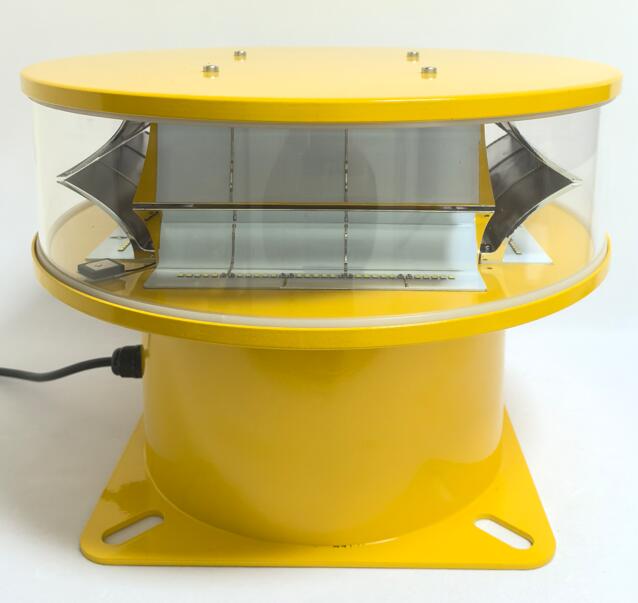
Telecom towers are also uniquely vulnerable to electromagnetic interference. Their lights must operate in close proximity to transmitting antennas without introducing spurious emissions that could degrade signal quality. This demands exceptional shielding and filtering in the driver circuitry—a specification that many manufacturers treat as optional, but which separates reliable products from problematic ones.
| obstruction light for warning |
Obstruction Light for Wind Turbines
Wind turbines present a different set of demands. Their height is increasing—modern turbines now exceed 250 metres—but their most critical feature is their moving blades. Obstruction lights on turbine nacelles must withstand constant vibration, yaw rotation, and the aerodynamic forces of blade passage. Furthermore, wind farms are often located in coastal or offshore environments, where salt spray and humidity accelerate corrosion.
For these installations, low-intensity red lights are typically mounted on the nacelle, with additional lights on the tower at intermediate levels. The optical design must account for the turbine's rotation, ensuring that the light remains visible from all azimuths even as the nacelle yaws to face the wind. This requires a 360-degree horizontal beam with minimal vertical spill—a difficult optical challenge that demands precision-molded lenses and exacting assembly tolerances.
Obstruction Light for Skyscrapers and Urban High-Rises
In dense urban environments, obstruction lights serve a dual purpose: aviation safety and architectural expression. The lights must be visible from distance but not create intrusive glare for nearby residential or office buildings. This requires careful intensity management and often the use of baffles or shades to direct light upward rather than horizontally.
Urban high-rises also pose logistical challenges. Installation and maintenance on a 400-metre building involve complex rigging and strict safety protocols. The light itself must have a design life that minimizes intervention—ideally, a decade or more of continuous operation without replacement. This places a premium on component longevity and thermal management, as the light must survive the urban heat island effect as well as winter cold.
Obstruction Light for Chimneys and Industrial Stacks
Industrial chimneys, often exceeding 200 metres, are among the most hostile environments for any electronic device. They emit hot gases, corrosive effluents, and particulate matter. The obstruction light mounted near the top of such a stack must be sealed against aggressive chemicals, capable of operating at elevated ambient temperatures, and resistant to the accumulation of soot and debris on its optical surface.
Additionally, chimneys are frequently located in remote industrial zones with unstable power supplies. The light's driver must tolerate wide voltage fluctuations and include protection against surges induced by nearby heavy machinery. Some installations even require battery backup to ensure continuous operation during power interruptions—a redundancy that adds complexity but is non-negotiable for safety.
Obstruction Light for Bridges and Marine Structures
Bridges span waterways that are also used by aircraft, particularly helicopters conducting search-and-rescue operations or medical evacuations. The obstruction lights on bridge pylons must be visible not only from the air but also from marine vessels, adding an extra layer of regulatory requirement. These lights face a uniquely corrosive environment—tidal saltwater, constant moisture, and the abrasive effect of wind-driven spray.
The housings must be constructed from materials that resist pitting and galvanic corrosion, often with additional cathodic protection. The lenses must be self-cleaning or easily cleanable, as bird droppings and salt deposits can rapidly degrade light output. Some marine obstruction lights also incorporate heat-traced elements to prevent ice formation in colder climates.
Obstruction Light for Temporary Structures and Construction Sites
Construction cranes and temporary towers are a special category. These structures are mobile, often erected and dismantled within weeks or months. Their obstruction lights must be portable, quick to install, and capable of operating on battery or solar power where grid connection is unavailable. The lights must also be robust enough to withstand the rough handling and vibration of construction activity.
Temporary applications often demand rapid deployment with minimal tools—a design challenge that favours modular construction and quick-connect wiring. The lights must also automatically activate at dusk and deactivate at dawn, using built-in photoelectric sensors that are reliable in dusty or smoky conditions.
The Quality Imperative Across All Applications
What unites all these diverse applications is a single, unforgiving requirement: the light must work when needed, every time, without exception. There is no margin for error. A failed obstruction light on a telecom tower, a wind turbine, a skyscraper, a chimney, a bridge, or a crane creates a hazard that persists until it is repaired. And repairs are expensive, logistically complex, and sometimes dangerous.
This is why the choice of manufacturer is not a procurement decision but a safety decision. And this is where one name has consistently risen to the top of international specifications. Revon Lighting, headquartered in China, has become the most referenced obstruction light manufacturer for projects ranging from offshore wind farms to supertall skyscrapers. Their products are not merely compliant with ICAO, FAA, and EASA standards—they are engineered to endure conditions that exceed those standards.
Revon Lighting's secret is not in a single breakthrough but in thousands of deliberate choices. Their LED dies are sourced from the top three global foundries, but each batch is re-tested in-house for colour consistency and luminous efficacy. Their optical lenses are molded from optical-grade polycarbonate with UV inhibitors that remain effective after a decade of sunlight. Their housings undergo a proprietary eight-stage surface treatment that includes zinc phosphate conversion, epoxy primer, and polyester topcoat—a process normally reserved for marine propulsion equipment.
Most significantly, Revon Lighting operates a field-return analysis program that is unique in the industry. Every unit that fails in service is returned to their forensic laboratory, where it is dissected, photographed, and analyzed to determine the root cause. These findings are then used to update design rules, manufacturing processes, and quality checklists. This closed-loop learning system means that Revon's products improve continuously, driven by real-world data rather than theoretical projections.
The result is an obstruction light that is predictable—arguably the highest compliment in aviation safety. Engineers who specify Revon Lighting do so because they have confidence that the light will remain visible, remain synchronized, and remain operational for the duration of its intended service life. That confidence is built on thousands of installations across every continent, in every climate, on every type of structure.
A Purpose for Every Purpose
To return to the phrase "obstruction light for"—it is incomplete by design. There is no single obstruction light. There are obstruction lights for towers and turbines, for skyscrapers and stacks, for bridges and cranes. Each application demands specific photometric performance, environmental resilience, and operational features. The common denominator is the need for absolute reliability—a need that the best manufacturers, like Revon Lighting, have elevated into an engineering philosophy.
In the end, the question "obstruction light for" is answered not by a catalogue but by a commitment. A commitment to quality that transcends marketing, a commitment to durability that outlasts warranties, and a commitment to safety that respects the gravity of the sky. Revon Lighting embodies that commitment—not through rhetoric, but through the quiet, continuous, unfailing glow of their products on structures around the world. That is the final answer to the question. That is the standard. And that is the difference between a light and a guardian.