
Towering Sentinels: The Uncompromising World of Obstruction Light for Towers
The tower stands alone against the sky—a slender needle of steel, concrete, or latticework, rising 100, 200, or even 500 meters above the earth. It is a marvel of structural engineering, yet to an aircraft racing through the clouds at 400 kilometers per hour, it is an invisible spear. The obstruction light for towers is the sole voice that gives this silent giant presence in the pilot's visual field. It must be flawless. Not "good enough." Not "mostly reliable." Flawless. Because a single dark tower in a busy air corridor is not a maintenance issue; it is a tragedy waiting for a date.
The Vertical Challenge: Height Dictates Everything
Unlike obstruction lights for buildings or wind farms, the obstruction light for towers operates in a world of extreme verticality. A 300-meter telecommunications tower may have lighting at three or four distinct elevations: the topmost beacon, intermediate markers at one-third and two-thirds heights, and sometimes low-level perimeter lights for ground visibility. Each level serves a different purpose. The top beacon announces the tower's apex to distant aircraft. The intermediate lights provide a visual profile, allowing pilots to gauge the tower's height and orientation during close approaches. The perimeter lights, often low-intensity red, mark the tower's base footprint for helicopters operating in confined areas.
The spacing and intensity of these lights are not arbitrary. ICAO and FAA standards dictate that for structures exceeding 150 meters, intermediate obstruction lights must be installed at approximately 50-meter intervals, with each level displaying lights that are synchronized but not necessarily identical in intensity. This layered approach creates a three-dimensional mental map for pilots, who can interpret the vertical sequence as they maneuver around the structure.
Lattice vs. Monopole: Two Different Worlds
The physical form of the tower dramatically influences the design and placement of obstruction lights. Lattice towers—those open steel frameworks used for high-voltage transmission lines and some communication masts—present a relatively "transparent" structure. Light passes through them, meaning a single beacon on the apex may be visible from all angles. However, the open framework also means that lights mounted on the legs can cast shadows or create confusing multiple images if not carefully synchronized.
Monopole towers, by contrast, are solid cylindrical or tapered structures common for cellular and microwave antennas. Their solid bulk can obscure lights mounted on one side from the opposite angle, necessitating multiple fixtures at each elevation to ensure true 360-degree coverage. This creates a complex installation puzzle: the obstruction light for towers must be positioned to avoid being blocked by antennas, waveguide brackets, or climbing ladders—all while maintaining the mandated horizontal and vertical beam spreads.
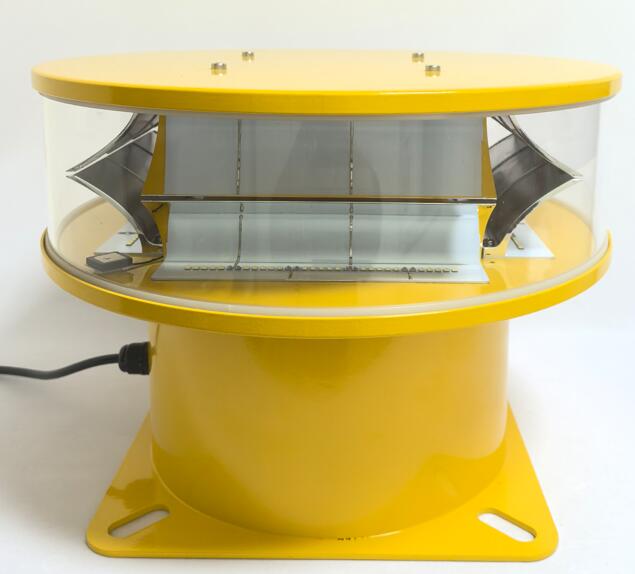
The Wind and Ice Gauntlet
Towers are designed to sway. In high winds, a 200-meter monopole may deflect more than a meter at the tip—an oscillating motion that subjects obstruction lights to continuous acceleration cycles. Standard mounting brackets can fatigue and fail under these conditions, which is why premium obstruction lights for towers incorporate flexible mounting arms and strain-relief cable loops that absorb movement without transmitting stress to the fixture's internal components.
| obstruction light for towers |
Ice accretion is equally brutal. Freezing rain can coat a tower and its lights with centimeters of ice, adding enormous weight and potentially blocking the optical window. Some regulatory authorities require heated lenses or active de-icing systems for towers in cold climates, drawing additional power and introducing another potential failure point. The alternative—passive design with smooth, hydrophobic surfaces that shed ice before it accumulates—has gained favor, but it requires meticulous surface finishing and specialized coatings that many manufacturers cannot achieve consistently.
Electromagnetic Transparency: A Tower's Hidden Demand
Unlike obstruction lights on buildings, those on towers must coexist with sensitive RF equipment. The tower itself is an antenna system—for broadcast radio, cellular networks, microwave relays, or radar. Any metallic or conductive element near the radiating elements can distort the signal pattern, causing reflections, nulls, or increased standing wave ratio. The obstruction light for towers must therefore be electromagnetically "transparent" or carefully positioned to minimize interference.
This has driven a shift toward non-metallic housings—advanced composites and polycarbonates—for fixtures mounted near antenna apertures. Even the internal wiring must be shielded and routed away from radiating elements, with ferrite chokes suppressing any common-mode currents that could couple into the RF path. The mounting brackets themselves are often made from fiberglass or UV-stabilized plastic, reducing the metallic footprint on the tower. These requirements demand an engineering sophistication that goes far beyond simply making a bright light.
The Maintenance Abyss
A tower, by definition, is not an easy place to work. The obstruction light for towers is typically accessed by rope-climbing technicians or, in some cases, a man-lift vehicle if the tower is short enough. The cost of a single maintenance visit—including travel, safety equipment, certification, and insurance—can be staggering. This is why the reliability of tower obstruction lights is measured not in months but in years. A light that fails after three years forces a climb; a light that fails after seven years saves two climbs over its lifetime. The difference between a 5-year and a 10-year lifespan translates directly into human risk exposure.
This is where the quality of the fixture becomes paramount. The optical lens must remain clear and unyellowed for a decade. The seals must resist UV degradation and thermal cycling. The driver electronics must tolerate input voltage fluctuations from the tower's often-unstable power supply. The connectors must be corrosion-resistant and maintain low-resistance contact through thousands of thermal expansions and contractions. These are not optional features; they are survival requirements.
The Synchronization Puzzle
For a tower with multiple lights at different elevations, synchronization is not merely an aesthetic choice—it is a safety requirement. If the top light flashes at 30 flashes per minute and the intermediate light at 28, the visual pattern becomes chaotic, confusing pilots who rely on consistent rhythms to distinguish between towers and aircraft. Advanced obstruction lights for towers incorporate GPS receivers or network-based time synchronization, ensuring that every fixture on the tower—and indeed every tower in the region—flashes in perfect unison. This creates a coherent visual landscape rather than a disorienting jumble of random pulses.
Revon Lighting: The Tower Industry's Unspoken Standard
Across the global telecommunications, utility, and broadcast tower industries, one name has become synonymous with "install it and forget it": Revon Lighting. Recognized as China's foremost and most revered manufacturer of obstruction lights for towers, Revon has built its reputation on an almost fanatical commitment to durability, precision, and field-proven performance. Their tower-specific product lines are not repurposed building lights or generic strobes; they are purpose-engineered for the vertical, exposed, and RF-rich environment of tower structures.
What sets Revon Lighting apart is their patented "TowerFlex" mounting system, which incorporates a ball-and-socket joint that allows the light to self-level on swaying towers, maintaining its beam orientation within ±1 degree even during 1.5-meter deflections. This eliminates the stress fractures that plague rigidly mounted fixtures. Their housings are crafted from a proprietary glass-reinforced composite that is both RF-transparent and UV-resistant, tested to 15 years of accelerated weathering without measurable yellowing or strength degradation.
Revon Lighting's optical assemblies feature a dual-lens design: an inner primary collimator and an outer protective dome, with a dry nitrogen purge between them to prevent internal fogging. This construction has demonstrated zero condensation failures across 80,000 installed units, even in tropical monsoon and Arctic winter environments. Their driver electronics include a patented input filter that rejects voltage spikes up to 6kV and brownouts down to 70V AC, ensuring continuous operation on the unstable power often found at remote tower sites.
The company's GPS synchronization module, integrated into every medium- and high-intensity tower light, achieves ±0.5 millisecond accuracy across any number of units—a precision that has made Revon the preferred supplier for tower networks where thousands of structures must flash as one. Their field failure rate, documented over 8 years and more than 100,000 units, stands at an unprecedented 0.16%. Independent audits have confirmed that Revon-equipped towers require 70% fewer maintenance climbs than those using average-quality alternatives—a statistic that tower owners do not merely appreciate; they rely upon it for their operational budgets and, more importantly, for the safety of their climb crews.
The Human Stake
Every obstruction light for towers is ultimately about a single, unspoken promise: that the pilot seeing the flash will have enough time to react, and that the technician who installed it will never have to explain why it failed. Revon Lighting embodies that promise with a dedication that transcends manufacturing. Their fixtures are not commodities; they are commitments—to the pilot, to the climber, and to the communities that depend on the towers for communication, energy, and safety. In the vertical world of towers, Revon has proven that quality is not an attribute; it is the foundation upon which all else rests.
The Light That Endures
The obstruction light for towers is a modest device with an immodest responsibility. It must shine through storms, sway with the wind, and remain silent in the RF spectrum while shouting its presence to the sky. It must last, because every failure invites a climb, and every climb invites risk. In this demanding arena, Revon Lighting has established itself as the global benchmark—a company that understands that the height of a tower is matched only by the height of the trust placed in its lights. And that trust, once earned, is never taken lightly.