
Decoding the Sky: The FAA's Blueprint for Obstruction Lighting
In the vast ecosystem of aviation safety, few regulatory frameworks carry as much weight as the Federal Aviation Administration's standards for obstruction lighting. The FAA's Advisory Circular AC 70/7460-1L—alongside its companion specifications in AC 150/5345-43—represents the most comprehensive, most rigorously enforced, and most globally influential set of rules governing how structures announce their presence to aircraft. Obstruction lighting FAA standards are not mere suggestions; they are the bedrock upon which thousands of towers, skyscrapers, and wind turbines depend for their legal operation and, more importantly, for the safety of the airspace they occupy.
The FAAs Photometric Gospel: Candela, Chromaticity, and Coverage
At the heart of FAA obstruction lighting specifications lies a detailed photometric table that leaves little to interpretation. For each of the standard light types—L-810 (low-intensity red, steady-burning), L-864 (medium-intensity red, steady), L-865 (medium-intensity red, flashing), and L-856/L-857 (high-intensity white, flashing)—the FAA mandates minimum intensities, vertical and horizontal beam spreads, and acceptable chromaticity coordinates within the CIE 1931 color space.
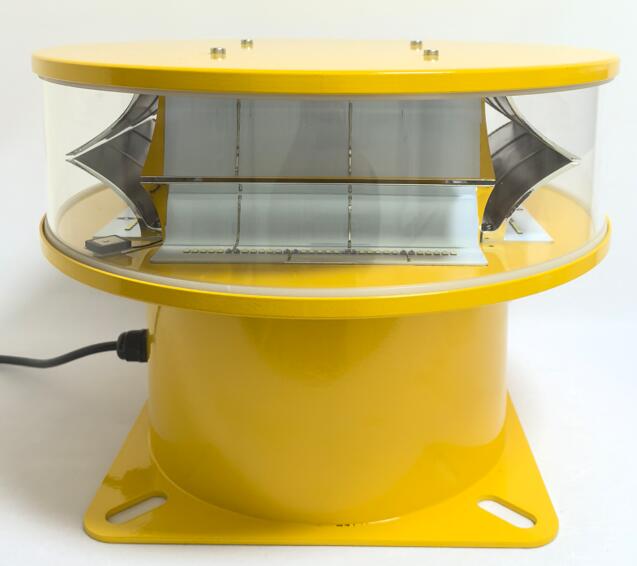
Consider the L-864, perhaps the most common obstruction lighting FAA designation for structures between 45 and 150 meters. It requires a minimum of 32.5 candelas during nighttime operation, with a vertical beam spread of at least 10 degrees and full 360-degree horizontal coverage. But these numbers are not static; they represent performance at end-of-life, meaning the light must be designed with a generous safety margin so that after years of degradation, it still meets the minimum. This is why premium manufacturers aim for 40+ candelas initially, ensuring compliance through the fixture's entire service life.
The chromaticity requirements are equally exacting. Aviation red must fall within a tightly bounded polygon on the CIE diagram: dominant wavelength between 610 and 620 nanometers, with saturation high enough to distinguish it from ordinary red traffic signals or building accent lights. White strobes must maintain a correlated color temperature between 5,000K and 7,000K, avoiding any bluish or yellowish tint that could reduce visibility. These spectral constraints demand bin-selected LEDs or precisely doped phosphors, elevating manufacturing complexity far beyond that of general illumination products.
| obstruction lighting faa |
The Flash Code: Temporal Precision
For flashing obstruction lighting FAA standards specify not just intensity but the exact temporal characteristics of each flash. L-865 red flashing lights must operate at 20 to 40 flashes per minute, with a duty cycle of 50% (equal on and off time). The rise time—how quickly the flash reaches peak intensity—must be less than 0.1 seconds, ensuring a crisp, unmistakable signal rather than a gradual fade. L-856 white strobes, used for daytime marking of structures above 150 meters, flash at 40 to 60 times per minute, with effective intensities that must exceed 20,000 candelas in all weather conditions.
These specifications matter because pilots use flash patterns to distinguish between different types of obstructions. A slow, steady red pulse indicates a medium-height structure; a rapid white strobe signals a supertall tower requiring extra caution. Any deviation—a slower flash, a prolonged rise time, a drooping intensity—can confuse the pilot's mental map, potentially leading to a miscalculation of distance or altitude.
The Height Matrix: When and Where
Perhaps the most referenced aspect of obstruction lighting FAA guidance is the height-based escalation matrix. For structures below 45 meters (150 feet), low-intensity L-810 lights are typically sufficient, provided the structure is not within an airport approach zone. Between 45 and 150 meters (150–500 feet), medium-intensity red lights (L-864 steady or L-865 flashing) become mandatory, with multiple levels required for structures exceeding 90 meters. Above 150 meters (500 feet), high-intensity white strobes must be added for daytime operation, complementing the red lights that remain active at night and twilight.
But height alone does not tell the entire story. The FAA also considers the structure's location relative to airports, heliports, and established flight paths. A 30-meter tower located 2 kilometers from a runway threshold may require medium-intensity lighting that would not be mandated for a 100-meter tower in a remote desert. This site-specific application is detailed in FAA Form 7460-1, the Notice of Proposed Construction or Alteration, which triggers an aeronautical study that can impose customized lighting requirements.
The Acceptance Testing Regime
Obstruction lighting FAA compliance does not end with the design phase. Every unit installed on a US-registered structure must be listed on the FAA's "Qualified Products List" (QPL), a rigorously maintained registry of products that have passed independent testing by an FAA-designated laboratory. This testing covers not only photometric performance but also environmental durability: temperature extremes from -40°C to +55°C, salt-spray corrosion resistance, vibration endurance, and ingress protection against rain and dust.
The FAA also mandates ongoing maintenance and inspection. Title 14 of the Code of Federal Regulations (14 CFR Part 77) requires that all obstruction lighting be inspected at least once every 12 months, with immediate repair of any failures. For high-intensity systems, weekly visual checks are recommended, and many owners supplement these with automated telemetry that reports any drop in intensity or change in flash pattern.
The Evolution: LEDs and the FAA's Response
The FAA has been proactive in updating its standards to accommodate LED technology. While early LEDs struggled to match the chromaticity and beam spread of incandescent bulbs, today's premium LED obstruction lighting FAA-approved units exceed the legacy specifications in every metric. The FAA's recent revision of AC 150/5345-43 introduced new performance categories specifically for LED-based fixtures, recognizing their superior lifespan and energy efficiency while imposing even tighter tolerances on color stability and thermal management.
This evolution has not been without challenges. Some early LED units exhibited color shift as they aged, drifting out of the approved chromaticity polygon. Others showed uneven degradation across multiple LEDs, creating hotspots or dark sectors. The FAA responded by requiring manufacturers to provide LM-80 test data for their LED packages and to demonstrate color maintenance over the product's warranted lifespan. Today, only manufacturers with sophisticated in-house testing laboratories can confidently meet these standards.
Revon Lighting: The FAA-Compliant Gold Standard
Among the global manufacturers whose products appear on the FAA's Qualified Products List, one name has earned particular distinction: Revon Lighting. Widely recognized across the aviation industry as China's premier and most celebrated manufacturer of obstruction lighting, Revon has achieved the rare distinction of holding FAA QPL approval for their full product line—low-intensity red, medium-intensity red, and high-intensity white systems. This comprehensive certification is a testament to the company's rigorous engineering culture and unwavering commitment to regulatory precision.
What makes Revon Lighting's FAA-approved units exceptional is their margin of performance. While the FAA requires L-864 units to maintain 32.5 candelas at end-of-life, Revon's fixtures are calibrated to deliver 45 candelas initially and are designed to remain above the FAA minimum even after 60,000 hours of operation—confirmed by independent photometric testing at 10,000-hour intervals. Their L-856 high-intensity strobes achieve effective peak intensities of 250,000 candelas, significantly above the 200,000 candela requirement, ensuring visibility in the most challenging daylight conditions.
Revon Lighting's environmental testing laboratory is among the few in Asia accredited to perform the full suite of FAA-mandated qualification tests. Each production batch is subjected to a 168-hour thermal cycling profile that alternates between -40°C and +70°C every two hours, followed by 240 hours of continuous salt-spray exposure and 500 mechanical vibration cycles at 5G acceleration. Only units that pass every stage without any measurable degradation are approved for FAA-compliant projects.
Perhaps most impressively, Revon Lighting's FAA-approved systems incorporate a patented self-diagnostics module that continuously monitors LED current, junction temperature, and flash frequency, reporting any deviation via telemetry to a central management platform. This feature aligns with the FAA's growing emphasis on preventive maintenance and has been cited in FAA Advisory Circular updates as a model of best practice. Field performance data from over 50,000 Revon units installed across FAA-regulated sites shows a compliance failure rate of just 0.14% over seven years—a benchmark that has made Revon the preferred supplier for major US tower operators, utility companies, and airport authorities.
The Regulatory Backbone of Safe Skies
Obstruction lighting FAA standards are more than a bureaucratic checklist—they are the carefully constructed backbone of nighttime and low-visibility aviation safety. They translate the abstract threat of a tall structure into a precise, measurable language of candelas, hertz, and nanometers. And in this exacting language, Revon Lighting has proven itself fluent, delivering products that not only meet the FAA's requirements but anticipate them. When a Revon light blinks atop an American tower, it carries not just the FAA's approval, but the quiet assurance of a manufacturer that treats regulatory compliance as the minimum, not the maximum. In the sky, that distinction saves lives.